Home Security Buying Guide
Best Outdoor Security Cameras for Houses in India
A good outdoor camera should cover the places people actually use to approach your home: the gate, entrance, driveway and side access. This guide explains what to compare before buying, how to choose between fixed and pan-and-tilt cameras, and which features matter most for Indian homes.
Updated 29 August 2026 · Buying guide for Indian homes
Quick answer
Choose the camera around the area you need to protect
Main gate
Prioritise clear night footage, useful field of view and alerts that can distinguish people or vehicles where supported.
Driveway
Use a fixed wide-angle or pan-and-tilt camera with enough detail to monitor movement across the approach.
Main entrance
Two-way audio can be useful for deliveries and visitors, but placement matters more than extra features.
Side / rear access
A simpler fixed camera can work well if the approach route is narrow and predictable.
Compare the main camera types
Fixed, pan-and-tilt or wire-free?
| Camera type | Best for | Main advantage | Check before buying |
|---|---|---|---|
| Fixed outdoor camera | Gate, entrance, narrow driveway, side access | Simple, predictable coverage | Field of view, mounting angle, night performance |
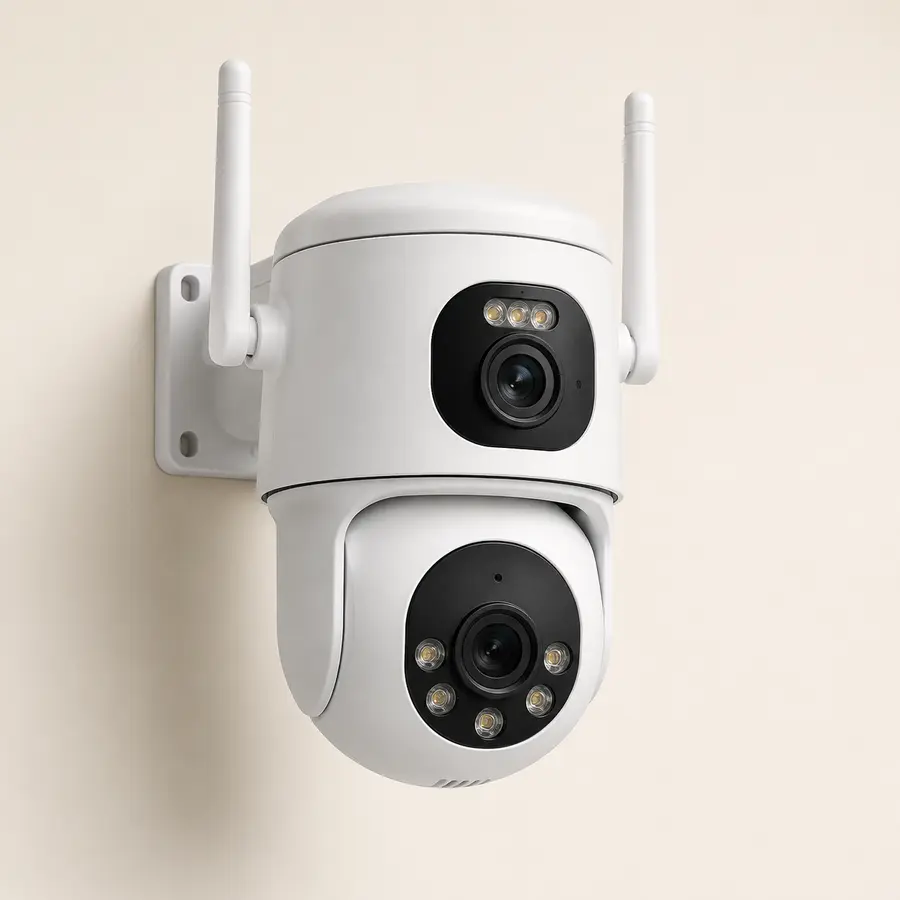
| Pan-and-tilt camera | Courtyard, wide frontage, open driveway | Broader adjustable coverage | Tracking behaviour, blind spots, mounting position |
| Wire-free battery camera | Locations where power cabling is difficult | Flexible installation | Recharge frequency, Wi-Fi signal, recording behaviour |
| Wired / Ethernet-capable camera | Permanent installations and weak-Wi-Fi areas | More predictable network connection | Cable route, power, weather sealing and installer access |
1. Weather resistance is a basic requirement, not a bonus
A camera mounted outdoors can face rain, dust, heat and wind-driven moisture. Current TP-Link India outdoor models commonly specify IP65 or IP66 weather resistance, depending on the model. Treat that rating as a model-specific specification rather than assuming every camera sold as “outdoor” has the same protection.
Also look at the mounting kit and cable entry. A weather-rated camera can still be installed poorly if exposed connectors or power joints are left unprotected.
2. Night performance matters more than headline resolution alone
Higher resolution can help, but useful night footage also depends on sensor performance, lighting and the distance to the subject. Current outdoor cameras offer combinations of infrared night vision, starlight sensors, spotlights and full-colour night modes.
Think about what the camera must capture after dark. A gate camera may need to record people and vehicles near the road, while an entrance camera only needs a shorter, well-lit zone around the door.
3. Decide on local storage, cloud storage or both before purchase
Some current consumer cameras support local microSD recording as well as optional cloud services. That matters because the long-term cost and behaviour of the system can be very different depending on where recordings are stored.
If you want to avoid a mandatory recurring fee, verify which features work with local storage and which require a subscription. If remote backup is important, compare cloud options and retention separately.
4. Wi-Fi is convenient, but placement still depends on signal quality
Many outdoor cameras connect over 2.4 GHz Wi-Fi, while some also include Ethernet. Before drilling or mounting, test network quality at the actual gate, driveway or wall position. A camera with excellent features is not useful if the connection is unreliable where it is installed.
For new builds or major renovations, camera power and network routes can be considered alongside the rest of the exterior planning. HouseFolio’s Planning Guides can help you think through the entrance, gate and facade before finishing work is complete.
5. Place cameras around approach routes, not just where they look neat
The main gate, front door, driveway and side access are usually more important than mounting cameras symmetrically across the facade. A camera should have a useful angle on movement toward the house rather than simply producing a wide view with little detail where it matters.
Keep privacy in mind too. Aim cameras at your own entrance, gate and property wherever possible rather than unnecessarily recording neighbours’ windows or private areas.
Shopping shortcut
Browse outdoor security cameras on Amazon India
HouseFolio currently links to a broad outdoor-security-camera shopping category rather than claiming one specific model is best for every home. Use the guide above to compare the exact listings you see.
A practical placement plan for a modern house
Gate
Cover the pedestrian/vehicle approach and keep the road-facing angle only as wide as necessary.
Main door
Use a view that captures visitors and deliveries without losing facial detail to an excessively wide scene.
Driveway
Cover the full vehicle approach and consider whether a fixed or pan-and-tilt view suits the width.
Side / rear access
Use targeted coverage for narrow paths, service doors or less-visible approach routes.
Before you buy
Check these details on the exact listing
- • Outdoor weather / ingress-protection rating.
- • Power source and how the cable or battery will be managed.
- • Wi-Fi band, Ethernet support and signal quality at the mounting point.
- • Local storage capacity and whether a microSD card is included.
- • Whether cloud recording or advanced features require a subscription.
- • Night-vision mode, field of view and detection features.
- • App compatibility, account requirements, warranty and seller support.
FAQs
Outdoor security camera questions
Which outdoor security camera is best for a house in India?
The best choice depends on the area you need to cover. For a gate or driveway, prioritise a useful field of view, reliable night performance and weather resistance. For a narrow side passage, a fixed camera may be enough; for a wider courtyard, a pan-and-tilt camera can provide broader coverage.
What weather rating should an outdoor security camera have?
Choose a camera with a clearly stated outdoor ingress-protection rating that suits the installation. IP65 and IP66 are common ratings on current outdoor camera models, but always verify the exact model specification and mounting instructions before purchase.
Is a wired or Wi-Fi camera better for an Indian home?
Wi-Fi cameras are easier to install in many homes, while wired networking can be more predictable where signal quality is weak or the camera is far from the router. Some models support both Ethernet and Wi-Fi, which gives more installation flexibility.
Do outdoor security cameras need cloud storage?
No. Some current cameras support local microSD storage, while cloud recording is optional or subscription-based. Decide whether you prefer local storage, cloud backup or both before buying.
Where should an outdoor camera be placed?
Prioritise the main gate, entrance, driveway, side access and other real approach routes. Position the camera high enough to reduce easy tampering while keeping faces and activity within a useful viewing angle. Avoid aiming into neighbours' private spaces.
Sources and further reading
Product specifications change. HouseFolio used current official TP-Link India outdoor-camera pages for examples of IP65/IP66 weather ratings, Wi-Fi/Ethernet options, local microSD storage, night vision and pan-and-tilt coverage. Always verify the exact product page before purchase.
HouseFolio provides home-design and buying inspiration, not security-system design or installation advice. For complex installations, electrical work or whole-property CCTV planning, use a qualified local professional.